Free printable · 14 nights · US Letter & A4
Free printable sleep and dream diary (14 days)
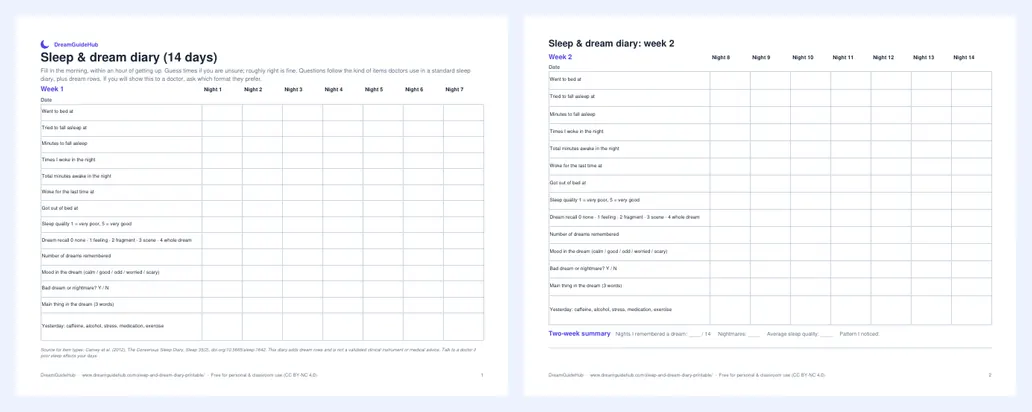
A sleep diary shows how you actually sleep. A dream journal shows what you dreamed. This two-page diary does both: one landscape page per week, with the usual sleep questions plus rows for dream recall, dream mood and nightmares. It takes about two minutes each morning, and after two weeks you can see patterns you would never spot from memory.
Download the free PDF
2 pages · US Letter and A4 · prints well in black and white · no sign-up
Best for: Anyone curious about their sleep, people trying to remember more dreams, and people preparing notes for a doctor or sleep clinic.
- Week 1 and week 2 on two landscape pages, one column per night
- 8 sleep rows (bed time, time to fall asleep, awakenings, wake time, quality), 5 dream rows and a row for the day before
- A two-week summary line to spot your patterns
Print at 100% or "actual size", not "fit to page". Free for personal, classroom and clinic use (CC BY-NC 4.0).
What each row is for
- Went to bed at / Tried to fall asleep at
- These can differ if you read or scroll in bed. Both help show how your evenings affect sleep.
- Minutes to fall asleep
- A rough guess is fine. Over two weeks you will see whether it is usually quick or slow.
- Times I woke in the night / total minutes awake
- Waking is normal. Patterns, such as waking at the same hour, are what matter.
- Woke for the last time at / Got out of bed at
- The gap between the two shows how long you stay in bed after waking.
- Sleep quality, 1 to 5
- Your own rating, with no right answer. Compare it with the dream rows.
- Dream recall, 0 to 4
- 0 is none, 1 a feeling only, 2 a fragment, 3 a scene, 4 a whole dream. It is the same scale as our recall checklist.
- Number of dreams remembered
- Counts separate dreams, not how long they were.
- Mood in the dream, bad dream or nightmare
- Lets you see whether upsetting dreams cluster on certain nights.
- Main thing in the dream (3 words)
- A tiny dream log, so the diary doubles as a lightweight dream journal.
- Yesterday: caffeine, alcohol, stress, medication, exercise
- A free-text row for anything that might be linked. Look for patterns, not proof.
How to use it for two weeks
- Print both pages and keep them with a pen next to your bed, where you will see them as you wake up.
- Fill in the morning column within an hour of getting up. Estimates are fine. Do not watch the clock at night.
- Write the dream recall score before anything else, because dreams fade fastest. Then fill in the sleep rows.
- On the last page, count nights with a recalled dream and nightmares, and write one pattern you noticed.
- If you want to keep the dream itself, add a line in a printable dream journal or copy the dream journal template.
Not remembering dreams is normal, and the research on why some people recall more than others is summarized in our plain-English dream research page. If you mostly want to improve recall, try the one-page dream recall checklist.
Source
Item types follow standard sleep diaries: Carney, C. E., et al. (2012). The Consensus Sleep Diary: standardizing prospective sleep self-monitoring. Sleep, 35(2), 287-302. doi.org/10.5665/sleep.1642. The dream rows are our own addition.
Questions people ask
Is this the same as a doctor's sleep diary?
It uses the same kinds of questions as standard sleep diaries (bedtime, time to fall asleep, awakenings, final wake time, rise time and sleep quality), which follow the Consensus Sleep Diary published by Carney and colleagues in 2012. It also adds dream rows, so it is not a validated clinical instrument. If you plan to show it to a doctor or sleep clinic, ask which format they prefer.
When should I fill it in?
In the morning, within about an hour of getting up, while the night is still fresh. Do not clock-watch during the night. Estimated times are fine, and you can leave a box blank if you do not know.
Why track dreams alongside sleep?
Dream recall varies from night to night, and so does sleep. Putting both on one page lets you see, for example, whether you remember more dreams after longer nights or whether upsetting dreams cluster on stressful days. These are your own patterns, not medical conclusions.
How long should I keep it?
Two weeks is a good start, which is why the diary has 14 nights. Print a second copy to keep going. If you want a month of dream detail, pair it with the 30-night printable dream journal.
What if my sleep is poor?
A diary can help you and your doctor see what is happening, but it is not a treatment. If you struggle to sleep most nights, feel very sleepy in the day, snore loudly or stop breathing in your sleep, or have frequent nightmares, please talk to a doctor.
Can I print it double-sided?
Yes. The two pages are landscape, one per week. Print at 100% on US Letter or A4, black and white is fine.
More free dream tools
Dream journal template and prompts
Copy-paste template for Google Docs, Notion, Obsidian or Apple Notes (also .docx and .txt), worked examples and 30 prompts.
OpenNightmare worksheet (imagery rehearsal)
Rewrite a bad dream while awake, then rehearse the new version with a 14-day log. Based on the method studied in clinical trials.
OpenReality check tracker and cards
A private tap-to-count tracker that works in your browser, plus 8 cut-out reality check cards and a 14-day printable tracker.
OpenDream analysis worksheet
A three-stage worksheet (explore, understand, act) for working on one dream, with facilitator notes for classes and groups.
OpenAlso free: printable dream journals, dream research in plain English, the dream glossary and everything on one page.
Share or cite this page
Writing about sleep, journaling or wellbeing? You're welcome to link to this page. Please link rather than re-uploading the PDF so readers always get the latest version. It is CC BY-NC 4.0.
HTML link
<a href="https://www.dreamguidehub.com/sleep-and-dream-diary-printable/">free printable sleep and dream diary</a> (DreamGuideHub)Citation
DreamGuideHub. (2026). Printable sleep and dream diary (14 days). Retrieved from https://www.dreamguidehub.com/sleep-and-dream-diary-printable/Last updated 28 November 2026. For self-reflection, not diagnosis.