Free tool · private, no sign-up · plus printable cards
Reality check tracker for lucid dreaming (with printable cards)
Reality checks are the best-known first step in lucid dreaming: stop several times a day, ask honestly whether you are dreaming, and test it. The hard part is remembering to do them. Use the tracker below to count your checks and see your streak, and print the cut-out cards to put where you will notice them. Everything runs in your browser and your tally never leaves your device.
Reality check tracker
Try this one now
Count your fingers
Ask yourself honestly, "Am I dreaming?" Then do the check and really look at the result. Look at one hand and count the fingers slowly, then count again. In dreams hands often look odd or the count changes.
Today
0 / 10
Day streak: 0
Last 7 days
- 0Mon
- 0Tue
- 0Wed
- 0Thu
- 0Fri
- 0Sat
- 0Sun
Your tally is saved only in this browser on this device. Nothing is uploaded, and clearing your browser data removes it.
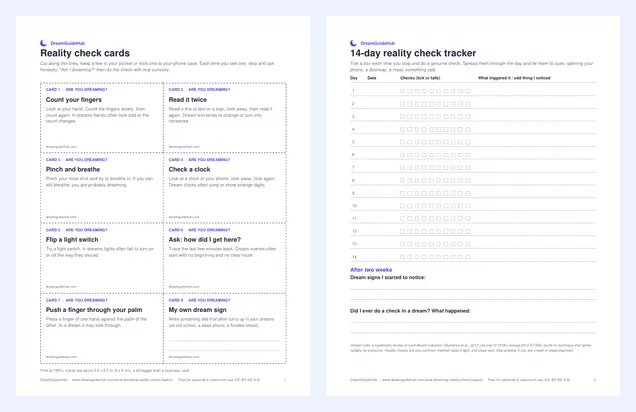
Download the free PDF
2 pages · US Letter and A4 · prints well in black and white · no sign-up
Best for: People starting lucid dreaming who want physical reminders, plus anyone who prefers pen and paper to an app.
- 8 cut-out reality check cards, including a blank one for your own dream sign
- A 14-day tracker with ten check boxes per day and a column for what triggered the check
- Two reflection prompts for after the two weeks
Print at 100% or "actual size", not "fit to page". Free for personal, classroom and clinic use (CC BY-NC 4.0).
The checks, and why they work
Dreams are bad at detail and consistency, which is what these tests exploit. Do each one slowly and look at the result, instead of going through the motions.
Count your fingers
Look at one hand and count the fingers slowly, then count again. In dreams hands often look odd or the count changes.
Read it twice
Read a line of text or a sign, look away, then read it again. Dream text tends to change or turn into nonsense.
Pinch and breathe
Pinch your nose shut and try to breathe in. If you can still breathe, you may be dreaming.
Check a clock
Look at a clock or your phone, look away, look again. Dream clocks often jump or show strange digits.
Flip a light switch
Try a light switch. In dreams lights often fail to turn on or off the way they should.
Ask: how did I get here?
Trace the last few minutes back. Dream scenes often start with no beginning and no clear route.
Push a finger through your palm
Press a finger of one hand against the palm of the other. In a dream it may sink through.
How to build the habit
- Pick cues, not times. Tie a check to something you do anyway: opening your phone, walking through a doorway, washing your hands, hearing a notification.
- Mean the question. Ask "Am I dreaming?" and consider it for a moment. A habit you repeat without thinking will also be repeated without thinking in a dream.
- Watch for dream signs. Note odd things that recur in your dreams, like an old school or a phone that will not work. Add one to a blank card and check whenever you see it.
- Write your dreams down. A dream journal is the foundation. Start with the free dream journal template or the 30-night lucid dreaming log.
- Give it a few weeks. Results vary a lot between people. Keep it light and do not lose sleep over it.
What the research says (honestly)
A systematic review of 35 studies of lucid dream induction found that none of the techniques reliably and consistently induced lucid dreams, although some looked promising, and the quality of the studies was relatively low (Stumbrys et al., 2012). In the International Lucid Dream Induction Study, 355 people kept a log for a week, then practiced reality testing, Wake Back to Bed and either MILD or SSILD for another week. MILD and SSILD were similarly effective, better general dream recall predicted success, and sleep quality was not harmed (Adventure-Heart, 2020).
The takeaway: reality checks are a reasonable thing to try, they work better alongside dream recall and other methods, and nobody can promise they will work for you. See our summary of the review, the summary of the induction study and the glossary entries for lucid dream, MILD and WILD.
- Stumbrys, T., et al. (2012). Induction of lucid dreams: a systematic review of evidence. Consciousness and Cognition, 21(3), 1456-1475. doi.org/10.1016/j.concog.2012.07.003
- Adventure-Heart, D. J. (2020). Findings from the International Lucid Dream Induction Study. Frontiers in Psychology, 11, 1746. doi.org/10.3389/fpsyg.2020.01746
Dream symbols that often come up with lucid dreams
Questions people ask
What is a reality check in lucid dreaming?
A reality check is a quick test you do during the day, such as counting your fingers or reading text twice, while genuinely asking whether you are dreaming. The idea is that if you build the habit awake, you may repeat it in a dream, notice that something is off and become lucid.
Do reality checks work?
Honestly, it varies. A systematic review of lucid dream induction found that no technique reliably works for everyone, though some looked promising (Stumbrys et al., 2012). In the International Lucid Dream Induction Study, MILD and SSILD (practiced alongside reality testing and Wake Back to Bed) were similarly effective, and better general dream recall predicted success (Adventure-Heart, 2020). Treat reality checks as an experiment and give it a few weeks.
How many reality checks a day should I do?
There is no proven number. People commonly aim for a handful a day, say 5 to 10, spread out and each done mindfully. Ten careless checks do less than three where you really stop and look. The tracker lets you set your own daily goal.
What is the best reality check?
The one you will actually do with curiosity. Reading text twice and looking at a clock twice are popular because dream text and numbers often change. Counting fingers is easy to remember. Whichever you choose, also ask 'how did I get here?'
Is my data private?
Yes. The tracker saves your tally in your browser's local storage on your own device. We do not receive it, there is no account, and you can export it as a CSV or delete it with one button.
Is lucid dreaming safe?
For most people, practicing is low-risk, but protect your sleep. Do not do techniques that cost you sleep if you are unwell or sleep-deprived, and talk to a doctor if you have a sleep disorder or frightening dreams. Never test a dream by doing something dangerous, like jumping from a height. Do the checks above, which are safe either way.
Where do I log what happened in the dream?
Use a dream journal. The 30-night lucid dreaming log has a nightly page for technique, lucidity level and dream signs, and the free dream journal template works too. Recording dreams is the most reliable first step.
More free dream tools
Dream journal template and prompts
Copy-paste template for Google Docs, Notion, Obsidian or Apple Notes (also .docx and .txt), worked examples and 30 prompts.
OpenNightmare worksheet (imagery rehearsal)
Rewrite a bad dream while awake, then rehearse the new version with a 14-day log. Based on the method studied in clinical trials.
OpenSleep and dream diary (14 days)
A two-week sleep diary with dream rows: bedtime, awakenings, sleep quality, dream recall, mood and nightmares, one week per page.
OpenDream analysis worksheet
A three-stage worksheet (explore, understand, act) for working on one dream, with facilitator notes for classes and groups.
OpenAlso free: printable dream journals, dream research in plain English, the dream glossary and everything on one page.
Share or cite this page
Writing about lucid dreaming? You're welcome to link to this page. The tracker is free and private, and the printable cards are CC BY-NC 4.0. Please link rather than re-uploading the PDF.
HTML link
<a href="https://www.dreamguidehub.com/lucid-dreaming-reality-check-tracker/">free reality check tracker and printable cards</a> (DreamGuideHub)Citation
DreamGuideHub. (2026). Reality check tracker and printable cards for lucid dreaming. Retrieved from https://www.dreamguidehub.com/lucid-dreaming-reality-check-tracker/Last updated 28 November 2026. For self-reflection, not medical advice.