Free printable · 2 pages · US Letter & A4
Dream analysis worksheet: explore, understand, act
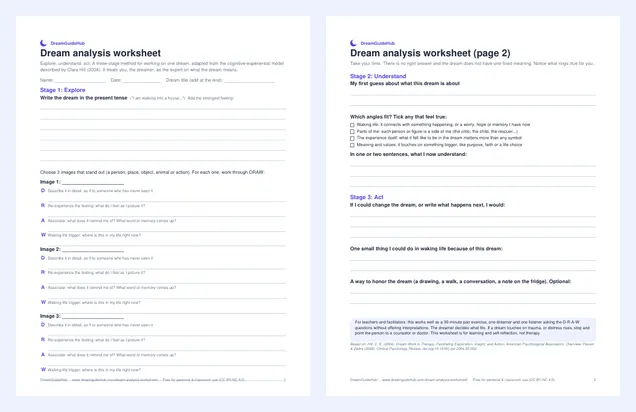
Most dream worksheets either give you a symbol list or leave you with a blank page. This one gives you a method. You write the dream in the present tense, pick three images that stand out, and work through four questions on each. Then you decide what the dream might be about for you and one small thing to do with it. It is adapted from a model that psychologists have studied in clinical research, and it is simple enough for a classroom.
Download the free PDF
2 pages · US Letter and A4 · prints well in black and white · no sign-up
Best for: Psychology and counseling students, teachers running a dream unit, dream groups, coaches, and anyone who wants to work on one dream properly.
- Stage 1, Explore: the dream in the present tense and a D-R-A-W grid for three images
- Stage 2, Understand: your first guess, four angles to tick and a summary sentence
- Stage 3, Act: change the dream or write a sequel, one waking-life step and an optional ritual
- A short facilitator note on the bottom of page 2
Print at 100% or "actual size", not "fit to page". Free for personal, classroom and clinic use (CC BY-NC 4.0).
The three stages in plain English
1. Explore. Retelling the dream in the present tense ("I am walking into a house") helps you re-enter it. Then you choose three to five images and ask four questions of each. Describe it in detail. Re-experience the feeling it brings. Associate: what does it remind you of? And name a Waking-life trigger: where is this in your life now? Together these are the D-R-A-W questions.
2. Understand. With what you have noticed, you make your own first guess at what the dream is about, then try a few angles. Does it connect to something in your waking life? Might each figure be a part of you? Does the experience of the dream matter more than any symbol? Does it touch on meaning or values? You finish with a sentence in your own words.
3. Act. Dreams are most useful when they lead somewhere. You imagine changing the dream or writing what happens next, choose one small waking-life step, and optionally find a way to honor the dream, such as a drawing, a walk or a conversation.
The method comes from Clara Hill's cognitive-experiential model (Hill, 2004), which has been studied in therapy research. Hill has said that people can work on their own dreams with these steps, though an outside perspective can help when you get stuck. It is one approach among several, and this worksheet is a simplified adaptation, not the clinical protocol.
Mini example (made up for illustration)
Dream: "I am in my childhood house and find a door I never noticed. Behind it are three extra rooms, all empty and full of light."
- Image: the new door. Describe: small, painted white, a bit stiff to open. Re-experience: curious, a little excited. Associate: "a part of the house nobody used". Waking life: I have been thinking about going back to study.
- Understand: "It feels like a room in me that I have not used." Angle ticked: waking life and parts of me.
- Act: look up one course this week and write the dream on the fridge as a reminder.
Notice that the dreamer, not the worksheet, decides the meaning. For traditional and psychological readings of an image like this, see our house dream meaning entry.
For teachers, counselors and dream groups
Pair exercise (about 30 minutes). One person is the dreamer, the other the listener. The listener follows the worksheet and asks only the D-R-A-W questions, with no interpretations and no advice. After the Understand stage, the dreamer summarizes in their own words. Then swap roles. A short debrief on what felt useful works well.
Ground rules that help: the dreamer chooses which dream to share and can stop at any time; nothing shared leaves the room; listeners never tell the dreamer what a dream means; and if a dream touches on something distressing, the facilitator points the person to a counselor or doctor.
Pairing with a journal. The 7-night starter in the printable dream journals gives students a week of dreams to choose from, and the dream glossary covers the vocabulary (REM sleep, continuity hypothesis, archetype).
Sources
- Hill, C. E. (2004). Dream work in therapy: Facilitating exploration, insight, and action. American Psychological Association.
- Pesant, N., & Zadra, A. (2004). Working with dreams in therapy: what do we know and what should we do? Clinical Psychology Review, 24(5), 489-512. doi.org/10.1016/j.cpr.2004.05.002
Questions people ask
Is this a dream interpretation worksheet that tells me what my dream means?
No, and that is deliberate. The method starts from the idea that you, the dreamer, are the best judge of what a dream means to you. The worksheet asks questions that help you explore the images, connect them with your life and decide what, if anything, to do. For traditional and psychological readings of individual symbols, use the A-Z dream dictionary alongside it.
Where does the three-stage method come from?
It is adapted from the cognitive-experiential model of dream work developed by psychologist Clara Hill, described in her 2004 book Dream Work in Therapy: Facilitating Exploration, Insight, and Action. Hill and colleagues have published many studies of the model. Pesant and Zadra (2004) review it alongside other approaches in Clinical Psychology Review. This worksheet is a simplified, self-help adaptation and is not the clinical protocol.
What does D-R-A-W stand for?
Describe the image in detail, Re-experience the feeling it brings up, Associate (what it reminds you of), and look for Waking-life triggers (where it shows up in your life now). You work through these four questions for three to five images that stood out.
Can I use it in a class or workshop?
Yes. It works well as a 30-minute pair exercise: one person shares a dream, the other asks the D-R-A-W questions without offering interpretations, then they swap. Print as many copies as you need. Please point students to a counselor if a dream touches on something distressing.
Do I need a recent dream with lots of detail?
A short or partial dream is fine. Pick the clearest images and the strongest feeling. A recurring dream or a childhood dream can work well too.
Is it a substitute for therapy?
No. It is a tool for learning and self-reflection. If dreams are linked with distress, trauma or sleep problems that affect your days, please talk to a doctor or a qualified therapist.
More free dream tools
Dream journal template and prompts
Copy-paste template for Google Docs, Notion, Obsidian or Apple Notes (also .docx and .txt), worked examples and 30 prompts.
OpenNightmare worksheet (imagery rehearsal)
Rewrite a bad dream while awake, then rehearse the new version with a 14-day log. Based on the method studied in clinical trials.
OpenReality check tracker and cards
A private tap-to-count tracker that works in your browser, plus 8 cut-out reality check cards and a 14-day printable tracker.
OpenSleep and dream diary (14 days)
A two-week sleep diary with dream rows: bedtime, awakenings, sleep quality, dream recall, mood and nightmares, one week per page.
OpenAlso free: printable dream journals, dream research in plain English, the dream glossary and everything on one page.
Share or cite this page
Teaching a dream unit or running a dream group? You're welcome to link to this page or print the worksheet for your class. Please link rather than re-uploading the PDF. It is CC BY-NC 4.0.
HTML link
<a href="https://www.dreamguidehub.com/dream-analysis-worksheet/">free dream analysis worksheet</a> (DreamGuideHub)Citation
DreamGuideHub. (2026). Dream analysis worksheet: explore, understand, act (free PDF). Retrieved from https://www.dreamguidehub.com/dream-analysis-worksheet/Last updated 28 November 2026. For learning and self-reflection, not diagnosis or therapy.