Free printable · imagery rehearsal · US Letter & A4
Nightmare worksheet: rewrite a bad dream, then rehearse it
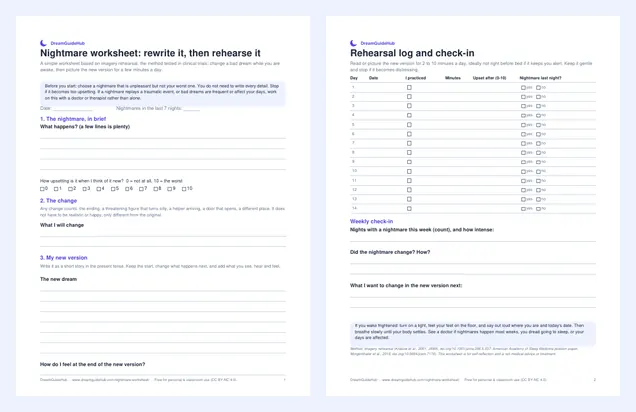
Imagery rehearsal is the nightmare method recommended by the American Academy of Sleep Medicine. You choose a bad dream, change it in any way you like while you are awake, and then picture the new version for a few minutes a day. This free two-page worksheet walks you through it: one page to write the change, one page to track two weeks of practice.
Download the free PDF
2 pages · US Letter and A4 · prints well in black and white · no sign-up
Best for: Anyone with occasional or recurring nightmares who wants a simple, structured way to try imagery rehearsal. Also handy as a client handout for therapists and counselors.
- Page 1: the nightmare in brief, a 0-10 distress rating, the change you choose and your new version
- Page 2: a 14-day rehearsal log (practiced, minutes, distress after, nightmare last night?)
- A weekly check-in and a short grounding note for waking up frightened
Print at 100% or "actual size", not "fit to page". Free for personal, classroom and clinic use (CC BY-NC 4.0).
How to use the worksheet, step by step
- Pick one nightmare. Choose one that is unpleasant but not your worst. Write a few lines about what happens and rate how upsetting it feels when you think of it now, from 0 to 10.
- Choose a change. Change anything: the ending, the setting, a threatening figure that turns silly, a helper who arrives, a door that opens. It does not have to be realistic or even happy, only different.
- Write the new version. Keep the start of the dream, change what happens next, and add what you see, hear and feel. Use the present tense, as if it is happening now.
- Rehearse it for a few minutes a day. Read the new version or picture it with your eyes closed. Many people practice for 2 to 10 minutes, during the day or early evening. Tick it off on the log and rate how upset you feel afterwards.
- Check in weekly. Count nights with a nightmare and see whether they are fewer or less intense. If the old nightmare keeps coming back unchanged, change the new version again, or try a different nightmare.
A short example (made up for illustration)
Original nightmare: "I am running down a school corridor and something I cannot see is behind me. The corridor never ends."
The change: the corridor has a side door, and behind it is my grandmother's bright kitchen.
New version: "I am running down the corridor. I notice a small wooden door on my left and open it. I step into my grandmother's kitchen. It smells of warm bread and the light is yellow. I close the door and sit down, and my breathing slows."
Notice that the new version keeps the start, changes the turning point, and spends time on senses and calm. It does not argue with the nightmare or explain it.
What the research says
In the first randomized controlled trial of imagery rehearsal, 168 women with chronic nightmares (95% had moderate to severe PTSD) had three sessions of the therapy. Nights per week with nightmares fell significantly, and sleep and PTSD symptoms improved, while a wait-list group changed little (Krakow et al., 2001). In 2018 the American Academy of Sleep Medicine's position paper named imagery rehearsal therapy as the recommended treatment for both PTSD-associated nightmares and nightmare disorder, which it says affects about 4% of adults (Morgenthaler et al., 2018).
The caveat is that these results come from clinician-led treatment. A printed worksheet is a way to try the same idea, not an equal replacement, which is why the worksheet tells you to get help when nightmares are severe. See the plain-English summary of the trial and the glossary entry on imagery rehearsal.
- Krakow, B., et al. (2001). Imagery rehearsal therapy for chronic nightmares in sexual assault survivors with posttraumatic stress disorder: a randomized controlled trial. JAMA, 286(5), 537-545. doi.org/10.1001/jama.286.5.537
- Morgenthaler, T. I., et al. (2018). Position paper for the treatment of nightmare disorder in adults: an American Academy of Sleep Medicine position paper. Journal of Clinical Sleep Medicine, 14(6), 1041-1055. doi.org/10.5664/jcsm.7178
For therapists, counselors and teachers
You are welcome to print as many copies as you need for clients or a class. The two pages are designed to be introduced in a session and then used at home: the first captures a brief account, a distress rating and the rewrite, and the second tracks daily rehearsal and nights with nightmares. The worksheet deliberately asks for only a few lines of the nightmare and tells the person to stop if distress rises. It is a handout, not an assessment tool, and it does not replace clinical judgment. The files are licensed CC BY-NC 4.0, so you can share and adapt them for non-commercial use with credit.
Prefer a longer pack with a nightmare log, recurring-dream profiles and three rewrite pages? Use the nightmare and recurring dream tracker.
Looking up what a nightmare image might mean?
Our dream dictionary covers common nightmare images. These readings are starting points for reflection, not diagnoses:
Questions people ask
Is this therapy?
No. It is a self-help worksheet that follows the basic steps of imagery rehearsal, a method clinicians use. It is for people with occasional or recurring nightmares who want to try it themselves, and for therapists and counselors who want a simple handout. If nightmares are frequent, replay a traumatic event, or affect your days, please work on them with a doctor or therapist.
Does imagery rehearsal actually work?
It is the nightmare treatment with the clearest professional endorsement. In a randomized controlled trial of 168 women with chronic nightmares, three sessions reduced the number of nights per week with nightmares (Krakow et al., 2001, JAMA). The American Academy of Sleep Medicine lists imagery rehearsal therapy as the recommended treatment for nightmare disorder and for PTSD-associated nightmares (Morgenthaler et al., 2018). Those results come from supervised treatment, so self-help results may differ.
Which nightmare should I start with?
One that is unpleasant but not your worst. Succeeding with an easier nightmare builds confidence, and you can move on to harder ones afterwards, ideally with professional support.
Do I have to write the whole nightmare down?
No. A few lines are enough, and you can stop if writing it upsets you. The method works on the imagery you rehearse, not on retelling every detail.
What if my new version is silly or unrealistic?
That is fine. The change can be absurd, magical or simply different: a door opens, the monster shrinks, a friend arrives. It only has to be a version you wrote and that feels less stuck.
How long until I notice a difference?
Some people see changes within a week or two, others need longer or need to change the new version again. Track nights with nightmares and how upsetting they are, so you can see the trend rather than judging a single night. If nothing changes after several weeks, talk to a doctor.
When should I see a doctor?
If nightmares happen most weeks, you dread going to sleep, you are very tired in the day, or a nightmare replays something that really happened to you. Also if you suspect another sleep problem, such as sleep apnea, which can be linked with nightmares.
More free dream tools
Dream journal template and prompts
Copy-paste template for Google Docs, Notion, Obsidian or Apple Notes (also .docx and .txt), worked examples and 30 prompts.
OpenReality check tracker and cards
A private tap-to-count tracker that works in your browser, plus 8 cut-out reality check cards and a 14-day printable tracker.
OpenSleep and dream diary (14 days)
A two-week sleep diary with dream rows: bedtime, awakenings, sleep quality, dream recall, mood and nightmares, one week per page.
OpenDream analysis worksheet
A three-stage worksheet (explore, understand, act) for working on one dream, with facilitator notes for classes and groups.
OpenAlso free: printable dream journals, dream research in plain English, the dream glossary and everything on one page.
Share or cite this page
Writing about nightmares, sleep or therapy resources? You're welcome to link to this page. Please link rather than re-uploading the PDF so readers always get the latest version. The worksheet is CC BY-NC 4.0.
HTML link
<a href="https://www.dreamguidehub.com/nightmare-worksheet/">free nightmare worksheet (imagery rehearsal)</a> (DreamGuideHub)Citation
DreamGuideHub. (2026). Nightmare worksheet (imagery rehearsal): free printable PDF. Retrieved from https://www.dreamguidehub.com/nightmare-worksheet/Last updated 28 November 2026. For self-reflection, not diagnosis. If nightmares or sleep problems affect daily life, please talk to a doctor.